
Left shift, right shift, Arneth curve deviation: what are we talking about?
All these terms are used to describe the degree of maturity of neutrophils.
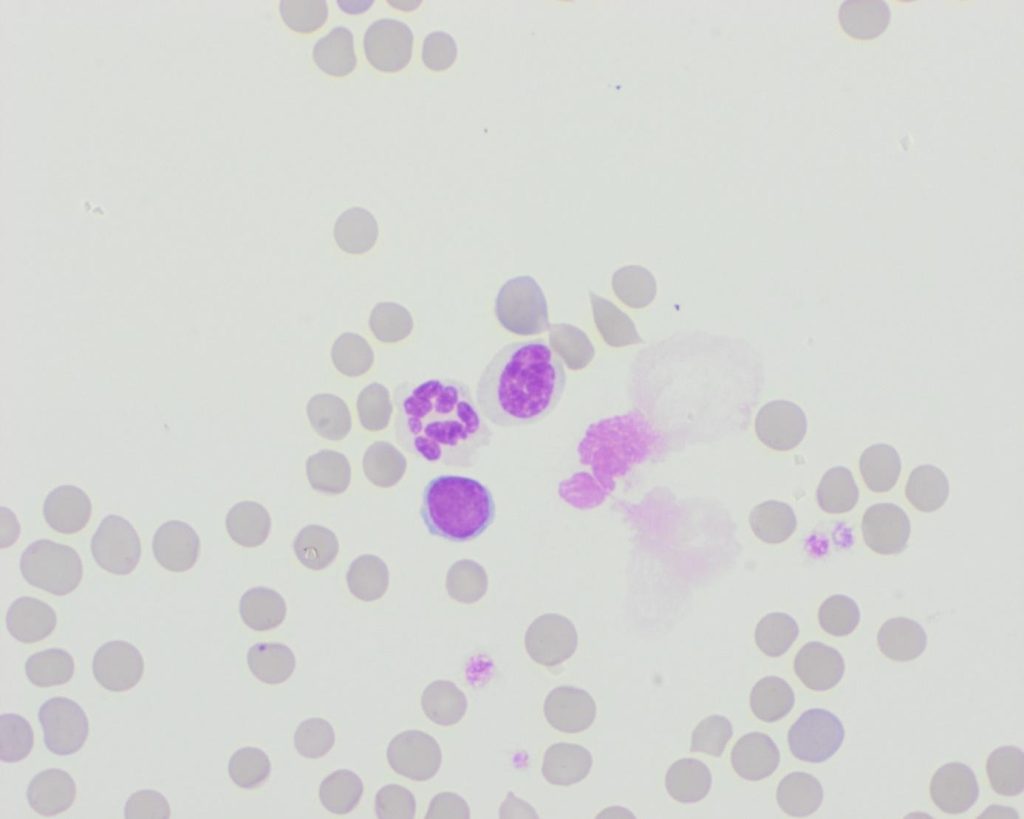
A left shift of the Arneth curve corresponds to the presence of more than 5% immature, hyposegmented neutrophils, also known as “bands.” These neutrophils have a “sausage-shaped” nucleus, lacking significant segmentation (by definition, at no point does the neutrophil’s nucleus measure less than two-thirds of its thickest area). This release of younger neutrophils into the blood indicates increased peripheral demand. It is a sign of inflammation.
A right shift on the Arneth curve corresponds to the presence of older, hypersegmented neutrophils in the blood. Hypersegmentation is defined as having 5 or more constrictions in the neutrophil nucleus. An increased number of these neutrophils is typically observed when “marginalized” neutrophils re-enter the circulation, which occurs notably under the effect of corticosteroids.
In fact, there are two populations of neutrophils in the blood vessels: those that are circulating, and those that are “marginalized.” Marginalized neutrophils are those that adhere to receptors on the surface of blood vessels and are ready to migrate into tissues (diapedesis). In cats, they account for nearly two-thirds of the neutrophils present in the blood vessels, which partly explains the particularly high neutrophilia following a corticosteroid injection in this species.
In the photo, you can see a lymphocyte at the bottom. Above it on the left is a hypersegmented neutrophil. Above it on the right is a band cell. The irregular pinkish area further to the right simply corresponds to a bare nucleus with chromatin that is disintegrating.