

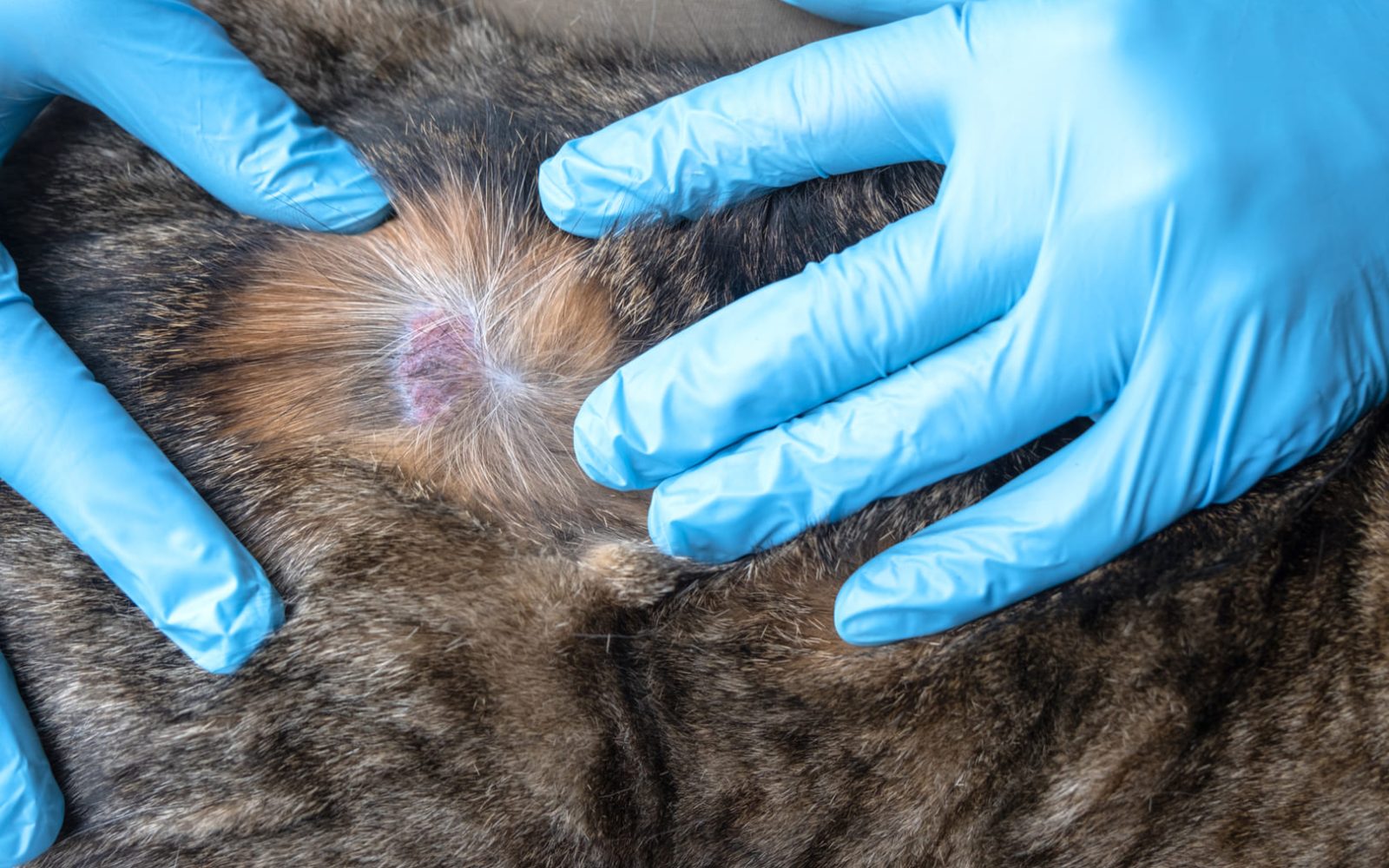
An 8-year-old Australian shepherd presented to the consultation for a skin mass discovered by his owners a week earlier. Location: right flank. Size: 3 cm. Consistency: soft, mobile under the skin. Not painful. General examination is unremarkable, the animal is in good general condition.
Faced with this classic situation, you have three options: remove, monitor, or explore. And skin cytology makes it possible to decide between these three options in just 30 minutes, without leaving the practice.
Why cytopuncture systematically?
Any new or evolving skin mass deserves a fine-needle cytopunction. The rule is simple: “what’s frequent is frequent”. In the field, the most common diagnoses are:
- Benign lipoma – 40-50% of skin masses in adult dogs
- Mastocytoma – critical diagnosis not to be missed
- Histiocytoma – benign, young dog, frequent spontaneous regression
- Sebaceous adenoma – benign, common in older dogs
- Squamous cell carcinoma – diagnosis not to be missed either
Without cytology, you run the risk of either surgically removing a trivial lipoma under general anaesthetic, or wrongly monitoring a mastocytoma that should have been removed with healthy margins.
The procedure: 3 punctures of 5 minutes each
Equipment required
5 mL syringe, 21 G needle, 3 microscope slides, Diff-Quik-type rapid stainer, microscope with 100× objective and immersion oil. That’s all there is to it. Minimal material investment, return on investment within a year.
Sampling technique
Stabilize the mass between two fingers. Insert the needle without suction. Vary the angle in the mass 3 to 5 times. Remove the needle. Fit the syringe (previously filled with air). Dispense contents onto a slide, spreading gently with another slide. Allow to air dry for 30 seconds.
Reading: what you’re looking for
At low magnification (×10), assess the cellularity and quality of the smear. At high magnification (×40 then ×100), identify the dominant cell type :
- Vacuolized fat cells + clear background = lipoma → reassure
- Round mast cells + metachromatic granulations = mastocytoma → excision with margins 2 to 3 cm
- Individualized round cells without granulations + mitotic activity = histiocytoma or other round cell tumors → expert cytology recommended
In our case, the slide shows a homogeneous population of vacuolated adipocytes on a clear background : diagnosis of benign lipoma. The owner is reassured, unnecessary anesthesia is avoided, and the consultation is billed at its fair value.
Going further: integrating cytology into your daily practice
This clinical case illustrates well what VETCYT teaches: cytology is the natural extension of your clinical examination. Not a specialist tool reserved for reference centers, but an everyday skill, accessible to any motivated practitioner.
If you want to go deeper, our level 1 course – The Fundamentals covers all common clinical situations in 44 hours and 88 modules: skin, lymph nodes, ear, effusions, urine. And for those who want to test beforehand, the B-A BA of cytology is entirely free.
To find out more about the specialty, visit our dedicated veterinary cytology training page.